MSAN - Memorandum on Legislation of Migori County Nutrition Policy
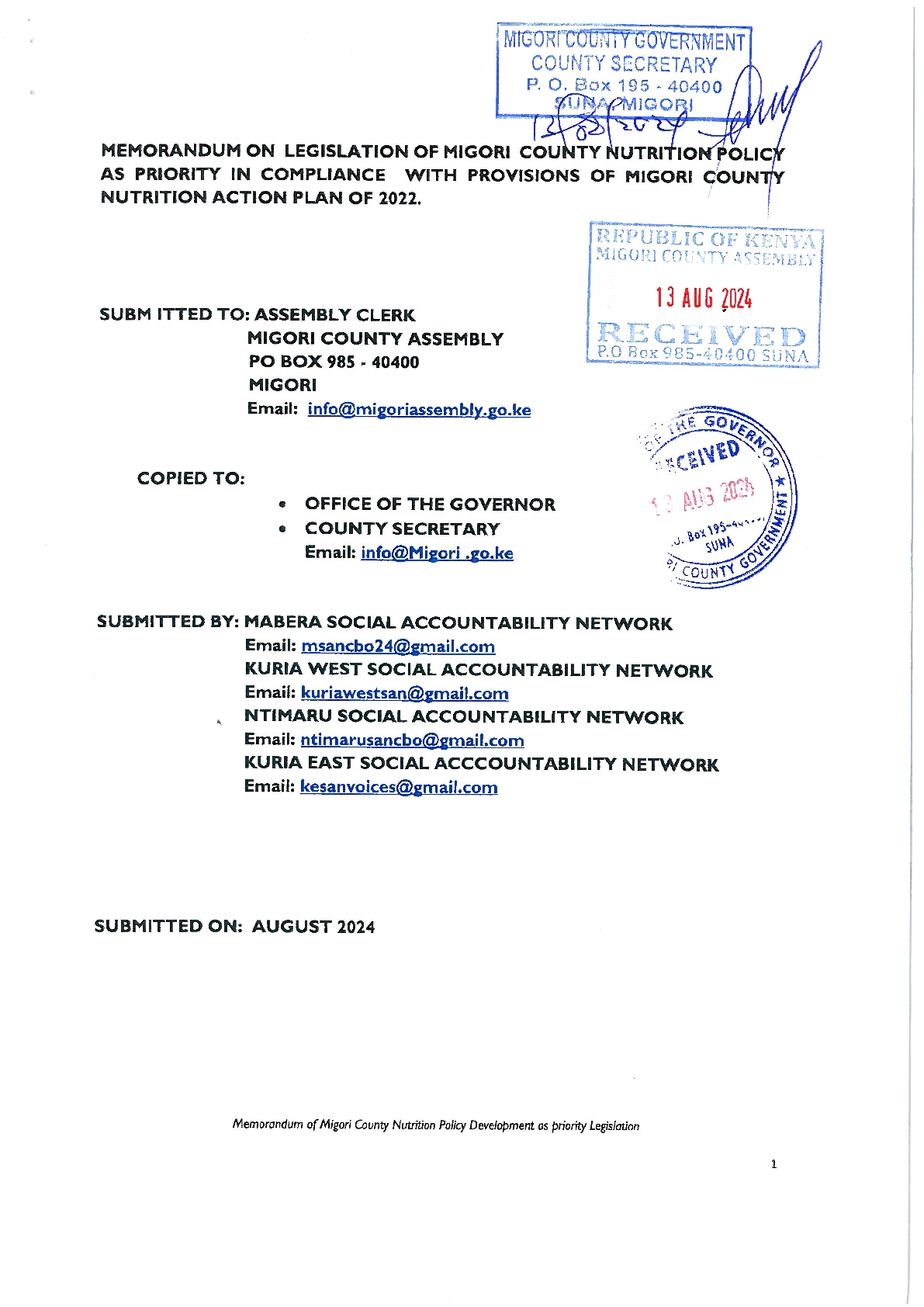
MEMORANDUM ON LEGISLATION OF MIGORI COUNTY NUTRITION POLICY AS PRIORITY IN COMPLIANCE WITH PROVISIONS OF MIGORI COUNTY NUTRITION ACTION PLAN OF 2022
The petition on the provision of access to information regarding the approved FY2024-2025 Migori County ward-based budget was submitted by multiple organizations, including the Mabera Social Accountability Network (MSAN). Here is a summary of the relevant details:
Memorandum Details:
- Title:Memorandum on Legislation of Migori County Nutrition Policy as priority in compliance with provisions of Migori County Nutrition Action Plan of 2022
- Submitted to:
- County Secretary: PO Box 195-40400, Migori; Email: info@migori.go.ke
- Office of the Governor, Migori County Government: PO Box 195-40400, Migori; Email: info@migori.go.ke
- Migori County Assembly: PO Box 985-40400, Suna-Migori; Email: info@migoriassembly.go.ke
- Received On: 13th August 2024
Submitting Organizations:
- Mabera Social Accountability Network (MSAN)
- Email: msancbo24@gmail.com
- Kuria West Social Accountability Network
- Email: kuriawestsan@gmail.com
- Ntimaru Social Accountability Network
- Email: ntimarusancbo@gmail.com
- Kuria East Social Accountability Network
- Email: kesanvoices@gmail.com
Submission Date:
- Date: 13th August 2024
1. Key Issues Raised
- Public Health: The memorandum emphasizes the importance of addressing malnutrition, which contributes to various health complications, by implementing a comprehensive nutrition policy in Migori County.
- Child Development: It highlights the critical role of proper nutrition in children's physical and cognitive development, which has long-term benefits for the community.
- Economic Productivity: Malnutrition negatively affects workforce productivity and increases healthcare costs, thus impacting the county's economic development.
- Poverty Reduction: The memorandum points out that poor nutrition both causes and results from poverty, and addressing it can help break this cycle.
- Food Security and Sustainable Agriculture: It underscores the need for policies that ensure food security and promote sustainable agricultural practices, especially in the face of climate change and economic challenges.
- Gender Equity: The document addresses the disproportionate impact of malnutrition on women and girls, calling for a gender-sensitive approach to nutrition.
- Cultural Considerations: It advocates for a nutrition policy that respects local dietary habits and cultural practices.
2. Legal and Constitutional Foundation
- Constitution of Kenya 2010: The memorandum cites Article 43(1)(c), which guarantees the right to be free from hunger and to have adequate food of acceptable quality. It also references the Fourth Schedule, which devolves health services and agriculture to county governments.
- County Governments Act, 2012: This act defines the roles of county governments, including responsibilities in health and agriculture, both of which impact nutrition.
- Public Health Act (Cap 242): The act provides the government with authority to implement programs that enhance public health, including nutrition policies.
- Food Security and Nutrition Policy (2011): Though not a statute, this policy reflects Kenya's commitment to addressing food security and nutrition, aligning with the Constitution's mandates.
- Kenya Vision 2030 and Medium-Term Plan (MTP): These national policy documents guide development efforts, including in agriculture and nutrition.
3. Prayers and Recommendations
- Assessment and Research: The memorandum requests comprehensive nutritional assessments and research to identify dietary needs and challenges in Migori County.
- Stakeholder Involvement: It calls for collaboration among government departments, NGOs, community leaders, health practitioners, and agricultural experts to formulate the nutrition policy.
- Funding: The document seeks appropriate budget allocation and financial support for policy development and implementation.
- Legislative Framework: The memorandum asks for the establishment of a legal framework to ensure the policy is consistent with national laws.
- Policy Objectives: It recommends clear objectives focused on reducing malnutrition, food insecurity, and diet-related illnesses.
- Implementation Strategies: The memorandum proposes specific strategies for policy rollout, including nutrition education, food fortification, and maternal and child health initiatives.
- Monitoring and Evaluation: It requests the development of a system to track policy progress and make necessary adjustments.
- Rights-Based Approach: The document insists that the policy adopts a rights-based approach in line with the Constitution's guarantees.
- Gender and Cultural Consideration: It demands that the policy takes into account gender-based nutritional needs and respects cultural practices.
- Education and Awareness: The memorandum includes provisions for ongoing public education on nutrition.
- SDGs Alignment: It recommends aligning the policy with Sustainable Development Goals, particularly SDG 2 (Zero Hunger).
- Incentives: The memorandum calls for incentives to support local food production and nutrition-sensitive consumption.
- Emergency Response: It seeks strategies for nutritional support during emergencies, particularly in hardship areas.
4. Specific Departmental Recommendations
- Health Department: The memorandum emphasizes the need for the Health Department to focus on reducing malnutrition and diet-related illnesses through various health initiatives and monitoring programs.
- Agriculture Department: It recommends promoting sustainable agricultural practices that enhance food security and nutrition, aligning with climate resilience strategies.
- Education Department: The document suggests incorporating nutrition education in schools to foster healthy dietary practices from a young age.
- Gender Department: The memorandum calls for the integration of gender-sensitive approaches in all nutrition-related policies and programs, ensuring equitable health outcomes.
- Emergency Response Department: It advises on developing plans to address nutritional needs during crises, particularly in areas prone to food scarcity.
[easy-share counters=1 counter_pos="inside" native="no" hide_total="yes" fullwidth="yes" fullwidth_fix="100"]